
Difficulty in Swallowing (Dysphagia) Treatment in Ludhiana
Consult Dr. Rajiv Grover, a leading digestive disorder specialist in Ludhiana, for precision-led function restoration and long-lasting relief from Dysphagia and complex swallowing disorders.

Dr. Rajiv Grover - Expertise in Eliminating Swallowing Difficulties Precisely
Through an exact identification of the cause of dysphagia, our expert dysphagia doctor in Ludhiana, Dr. Rajiv Grover, provides tailored care, combined with effective medicines and treatment processes. Ensuring a safe treatment approach, along with preventing malnutrition, are the most preferred factors by our expert, providing you with exceptional care throughout the treatment process.
Decoding Dysphagia: Why Swallowing Becomes Painful
Experiencing a choked feeling, unexplained sensation and painful swallowing during your meal time are mainly associated with swallowing difficulty or dysphagia.
Sometimes, swallowing your own saliva can result in sharp pain, making it come out of your mouth. Numerous reasons are responsible for weakening your food pipe or negatively affecting your throat, causing complex swallowing difficulties. Neurological issues, such as stroke, or muscle issues, make it extremely difficult for you to swallow during your mealtime. Structural blockages, such as GERD and specific problems in your esophagus, make it difficult for you to pass your food down.
Going through such agonising pain and discomfort can even make you deficient in essential nutrients, impacting your body strength. Undergoing difficulty swallowing treatment in Punjab can bring a sudden shift in your life, simplifying your swallowing process.
Identify Dysphagia: Common Indicators to Keep An Eye On
Immediate choking and coughing while eating
Observing a gagging sound, followed by sharp pain
Experiencing drooling or food spilling
Nose regurgitation & frequent heartburn
Experiencing stuck food in the chest
Hoarse or “wet” sound during meal time
Dysphagia Warning Indicators: Know When To Get Checked By Professionals
Observing the critical signs of swallowing troubles and calling out the swallowing problem doctor in Ludhiana is what can bring a transformative change in your life.
- Constant weight loss, resulting in malnutrition
- Coughing persistently, observing a gagging sound regularly
- Unable to swallow saliva and food, resulting in drooling
- Repeated chest infections and vomiting
- Breathing difficulties and pneumonia

Treatment Approach
Make Your Meals Easier And Faster: Dr. Rajiv Grover's Approach For Swallowing Comfort
Making a correct assessment is the middle name of Dr. Rajiv Grover, making an accurate analysis of your symptoms to reach the main cause. Due to his extensive and diverse knowledge regarding the structural blockages and impaired esophageal functioning, he has been actively engaged in providing personalized food pipe blockage treatment in Ludhiana.
Approaching you thoughtfully for thoroughly considering your symptoms and altering the treatment plan accordingly is the key factor for making him specialized in the clinical field. Restoring your swallowing function by targeting the exact root cause and improving meal activity are our treatment approaches for providing long-lasting relief.
Let’s Get Started
First and foremost, we ensure to have a thoughtful conversation, including specific details regarding your medical history and symptoms you have been struggling with. You can freely explain your symptoms and daily life disruptions, as it can help us in finding out the exact cause, providing an altered treatment accordingly. Also, identifying the specific risk or warning signs regarding swallowing difficulty has been thoroughly discussed through our initial consultation, driving the path towards improved digestion and easier swallowing.
Our Diagnostic Edge
Beyond the thorough analysis of your surface level symptoms, we ensure to go deeply and prefer doing some advanced diagnostic tests for your swallowing difficulties. With the help of CT/MRI or X-ray scan, your different esophageal issues are addressed, including the structural abnormalities and motility issues. Such conditions can apparently help us identify the exact root cause and find the best treatment process for managing your swallowing problems. Also, Dr. Rajiv Grover is specialised in performing endoscopic procedures for thoroughly diagnosing the real problem behind your painful swallowing with the purpose of reaching an effective treatment plan.
- Evaluation of achalasia & motor function through Esophageal Manometry
- Cancer detection through Endoscopic Ultrasound
- Identifying Inflammation through High-Resolution Esophageal Manometry
- Structural Abnormality through Upper GI Endoscopy
Targeted Healing Solutions
As mentioned above, the initial consultation is our key factor for altering a treatment plan for your dysphagia. Therefore, Dr. Rajiv Grover has extensive specialization in thoroughly analysing different symptoms and conditions of thousands of patients. Therefore, a treatment plan is altered accordingly to align it with the patient’s needs and specific condition, gradually eliminating the symptoms of dysphagia, thus making meals smooth.
- Endoscopic interventions for fixing the esophagus structural abnormalities, such as widening it precisely.
- Managing GERD and esophagus muscle spasm through effective medicines and follow-up guidance.
- Fixing the structural issues and relaxing the esophagus muscle tension through therapeutic endoscopic procedures:-
- SEMS Esophageal Self-Expandable Metallic Stents
- Esophageal Stricture Dilatation
- Peroral Endoscopic Myotomy
- Surgical procedures for complex and severe conditions
Risks & Complications
Why Ignoring Dysphagia Is Not Recommended? Scroll To Know Hidden Dangers
Your condition can be worsened if you keep delaying the dysphagia treatment even after experiencing its major signs.

Choking hazards are a life-threatening condition

Malnutrition, noticeable and rapid weight change

Pneumonia, a serious lung infection

Chronic dehydration lowers energy levels
Why Choose Us?
Why You Should Trust Dr. Rajiv Grover For The Best Treatment Of GERD and Heartburn
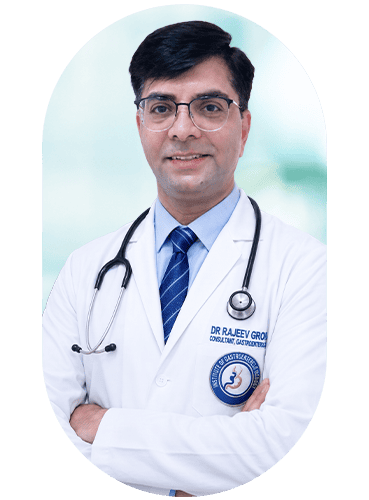
Leave your gastro and liver care in the expert hands of Dr. Rajiv Grover, proficient in handling complex cases with great comprehension.
01
International-based health protocols
Grover Gastro and Fertility Centre is aligned with international protocols that regulate the standard of effective treatments with the aim of achieving lasting results. As such, the clinic can be trusted to provide high-quality treatment procedures.
02
Evidence- based treatments
Dr. Rajiv Grover provides scientifically proven treatments that have a track record in achieving satisfying, effective results. He is vastly experienced in providing customized treatments that address the root of the condition with precision.
03
State-of-the-art technical facility and treatments
Grover Gastro and Fertility Centre has various advanced facilities that help to give better results for treatments. Dr. Rajiv Grover endeavors to provide treatments that achieve precision, long-lasting results and prioritises the safety of the patient.
04
Patient-centric care throughout the procedures
Grover Gastro and Fertility Centre goes beyond providing treatments, but also aims to ensure that patients receive the care and comfort they need throughout the treatments.
Frequently Asked Questions
Make sure to start by taking small but nutritious meals to manage your hunger and energy levels. Also, incorporate soft and pureed food in your daily diet to manage your hunger
Soft food such as yogurt, pudding and pureed vegetables are the ones that can be incorporated into your regular diet. Also, choose comforting food such as mashed food items so that the food can easily go down.
- Yes, due to dysphagia, your speaking ability would also be affected, making you unable to pronounce words, resulting in slurred speech.
For some measurable relief, you can try gargling with warm water, including a pinch of salt, along with having warm broth.
Yes, avoiding spicy food items during your achalasia treatment in Punjab is necessary for thoroughly protecting the sensitive lining of your esophagus.